Facility standards
Scoping commercial restroom cleaning properly
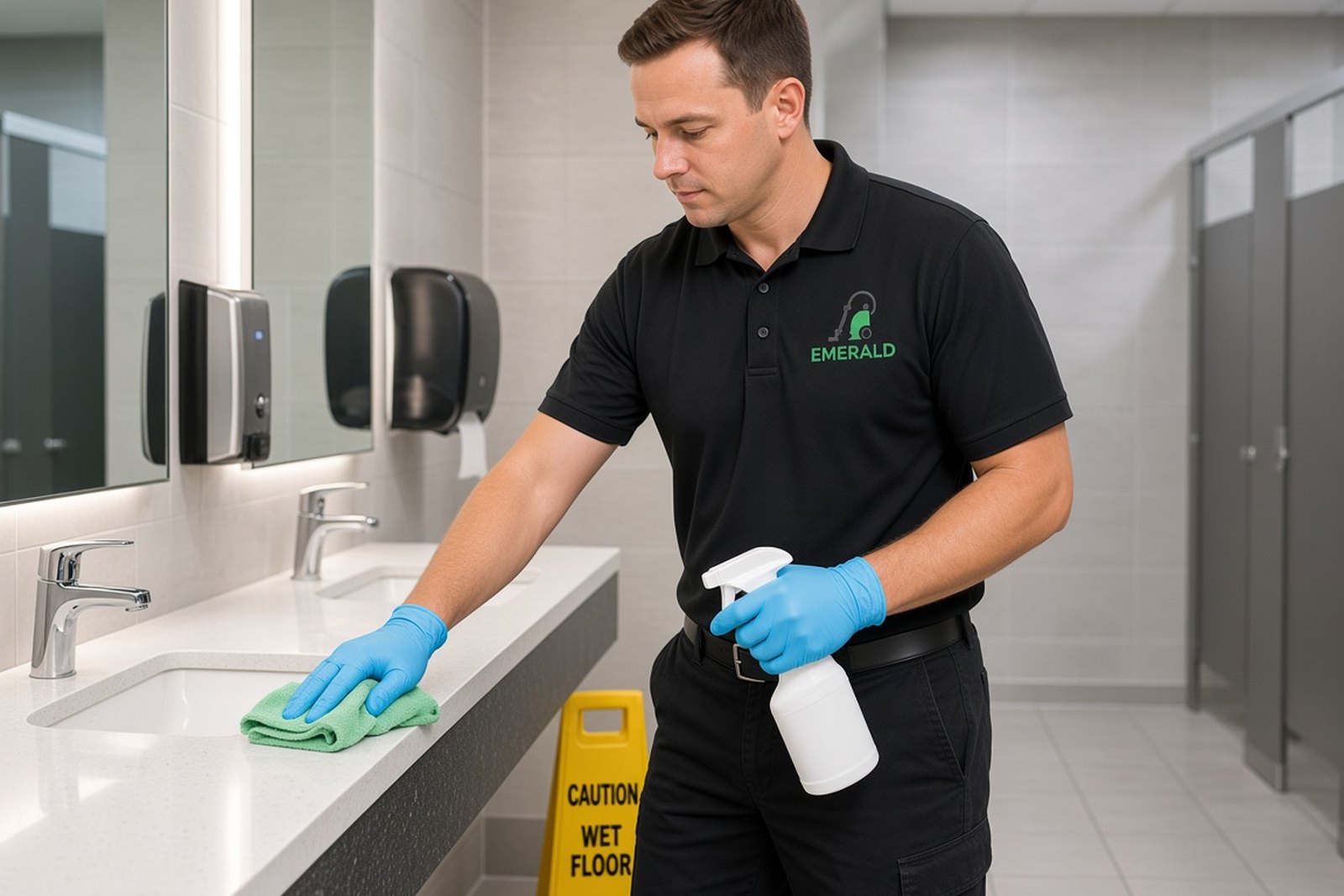
Restrooms generate more complaints than any other room in a commercial building, and they are the biggest labour variable in a janitorial bid. Almost every dispute we see traces back to a scope line that said clean daily and left the frequency, the supply checks and the standard undefined.
Short answer
A commercial restroom scope needs three numbers, not one: how many full-service visits per day, how many supply-monitoring checks, and what appearance standard those visits are meant to hold. Low-traffic restrooms need one full service daily. High-traffic public restrooms need three to four. The phrase clean daily defines none of the three.
Set frequency by traffic class, not by building size
Restroom frequency should follow daily user volume rather than square footage. A 30,000-square-foot warehouse with 20 staff needs less restroom service than a 4,000-square-foot clinic seeing 90 patients a day.
| Traffic class | Full-service visits | Supply checks | Typical Eastern Ontario sites |
|---|---|---|---|
| Low, staff only | 1 per day | Included in the full service | Professional offices, small warehouses, village storefronts |
| Moderate, staff and visitors | 1 per day plus a mid-shift check | 1 mid-shift | Clinics, dealerships, schools, condo amenity areas |
| High, public facing | 3 to 4 per day | Between each full service | Hotels, busy retail, arenas, restaurants, event venues |
| Surge and event | Structured visits before opening, mid-operation and at close | Continuous during peaks | Seasonal Picton and Brighton visitor traffic, tournament weekends |
A full service means cleaning and disinfecting fixtures, restocking, emptying waste and mopping. A supply check confirms consumables and spot condition only.
Write the scope line so it can be inspected
A defensible restroom scope line names the full-service frequency, the monitoring frequency and the appearance standard together. Written that way, the work can be inspected, scored and corrected instead of argued about.
A usable line reads: restroom full service twice daily at 7 AM and 1 PM, supply monitoring mid-shift, appearance standard held between services. That sentence tells a crew what to do, tells a manager what to check, and tells both sides what failure looks like.
Facilities that use the APPA appearance levels should state the level in the contract rather than assume it. Level 1 is a showpiece standard that requires the highest frequency, Level 2 is the ordinary professional standard for most commercial buildings, and anything below Level 3 will be visible to occupants.
- Name the full-service times, not just the count, if the building has fixed traffic peaks
- State who supplies paper, soap and liners, and who restocks them
- Set a response time for a reported restroom issue separate from the routine schedule
- List periodic work such as partition washing, grout detail and floor drain service with its own frequency
- Identify any restroom that must not share mops or cloths with other areas
Fixture count drives both labour and consumable cost
Fixture count, not floor area, is what makes restrooms expensive. Each toilet, urinal, sink and dispenser adds cleaning time on every visit and adds consumable draw across the month.
When you request a quote, give the number of restrooms and the fixture count in each. A vendor who prices from square footage alone is guessing, and the correction will arrive as a scope reduction or a price increase after the first month.
This is also why a small medical office can cost more per square foot than a large warehouse. The clinic has more fixtures and more detail per square foot, and the disinfectant needs its full wet contact time on every surface.
What a full restroom service actually includes
A complete commercial restroom service covers fixtures, dispensers, waste, touchpoints, mirrors, partitions and floors in a fixed order, with disinfectant given its labelled contact time rather than wiped dry immediately.
- Fixtures and dispensersToilets, urinals, sinks and taps cleaned and disinfected, with dispensers wiped and refilled from the agreed supply source.
- TouchpointsDoor handles, push plates, partition latches, light switches and flush levers, which are the surfaces occupants actually contact.
- Mirrors and chromeCleaned to no visible spotting, because water spots are what occupants read as a dirty restroom.
- Partitions and wallsSpot washed on every visit, fully washed on a periodic frequency named in the scope rather than whenever it gets noticed.
- Waste and linersEmptied and relined every visit, including sanitary units on their own disposal arrangement.
- Floors and cornersDamp mopped with a disinfectant cleaner, with attention to corners, baseboards and behind fixtures where odour actually originates.
- Dedicated toolsRestroom mops and cloths kept separate from other areas, and in daycare or diapering rooms never shared with any other space.
Odour is a floor and drain problem more often than a fixture problem
Persistent restroom odour usually comes from soil in grout joints, floor drains and the seam behind fixtures rather than from the fixtures themselves. Increasing spray frequency will not fix it; a periodic floor and grout restoration will.
If a restroom smells within an hour of a full service, the nightly routine is not the failure. Ask for a grout and drain assessment and add a periodic restoration visit to the calendar rather than doubling a daily task that was never the cause.
Eastern Ontario winters add a second variable. Salt and grit tracked from entrances grind into restroom grout near high-traffic doors, so a winter mat plan and a vestibule clean protect the restroom floor as much as the lobby.
How Emerald Cleaners scopes restrooms
We count fixtures during the walkthrough, set a frequency against the building's actual traffic, and write the full-service and monitoring frequencies into the quote as separate lines with the periodic work listed on its own schedule.
Restrooms are the first thing we look at in a commercial walkthrough, in Belleville, Kingston, Trenton or anywhere else in the region, because they decide most of the labour plan. If an agreed restroom task is missed, tell us within 24 hours and we return to correct it.
For clinics and dental offices, our environmental cleaning sits alongside your own infection control program rather than replacing it. The requirements are covered in our guide on Ontario IPAC expectations for dental and medical offices.
Sources referenced
Helpful answers
Frequently asked
How often should a commercial restroom be cleaned?
Low-traffic staff restrooms need one full service per day. Moderate-traffic restrooms with visitors need one full service plus a mid-shift check. High-traffic public restrooms need three to four full services per day with supply checks in between. Frequency should follow daily user volume, not building size.
What does clean daily actually mean in a cleaning contract?
On its own it means very little, which is why it causes disputes. A usable scope line states the number of full-service visits, the number of supply-monitoring checks and the appearance standard those visits are meant to hold, so the work can be inspected rather than debated.
Why do restrooms cost so much in a janitorial quote?
Restrooms are the highest-labour room per square foot and fixture count drives consumable cost. Each toilet, urinal, sink and dispenser adds time to every visit, so a small building with several washrooms can cost more than a larger building with two.
Why does our restroom still smell after it is cleaned?
Persistent odour is usually soil trapped in grout joints, floor drains or the seam behind fixtures rather than on the fixtures. A periodic grout and drain restoration addresses the cause. Increasing the frequency of a nightly wipe-down generally does not.
Do you restock paper and soap?
Yes, when it is in the agreed scope. Consumables can be supplied by the facility or included in our quote, and the written scope states which arrangement applies along with who monitors the stock levels.
Keep exploring
Related cleaning pages

Office Cleaning
Recurring workplace cleaning shaped around occupancy, access and business hours.
Explore this option ->
Medical Office Cleaning
Site-assessed cleaning for reception, staff and non-clinical patient areas.
Explore this option ->
Restaurant Tile & Grout Cleaning
Commercial floor cleaning focused on reducing built-up grease and soil.
Explore this option ->Start with the property
Get a written scope for your building
Share the address, facility type, approximate square footage and preferred service window. We will arrange a walkthrough and a free written estimate.