This guide shares practical considerations based on the kinds of commercial facilities our team serves across Eastern Ontario.
Three-stream waste fails on contamination, not on effort. Here is how Eastern Ontario facilities should divide the work between the cleaning crew, the hauler and their own staff.
Emerald Cleaners wrote this guide for commercial facilities in Eastern Ontario. It is operational advice for this topic, not a copied template and not medical or legal advice.
Waste handling is drifting into the cleaning contract
Something is shifting in this industry. In 2025, roughly 28 percent of building service contractors planned to add composting services within a year. By 2026 that figure had jumped to about 68 percent, one of the largest year-over-year changes in the sector, and recycling services moved the same direction. Nearly half of contractors say they are broadening their service offering.
The reason is on the buyer side. Facility managers increasingly want one accountable vendor and fewer contracts to administer, so waste, recycling and organics get pulled toward whoever is already in the building every night. That is usually the cleaning company.
The risk in that drift is vagueness. Waste handling covers several genuinely different jobs, and a scope line that just says garbage removal hides most of them.

Three different jobs people call garbage removal
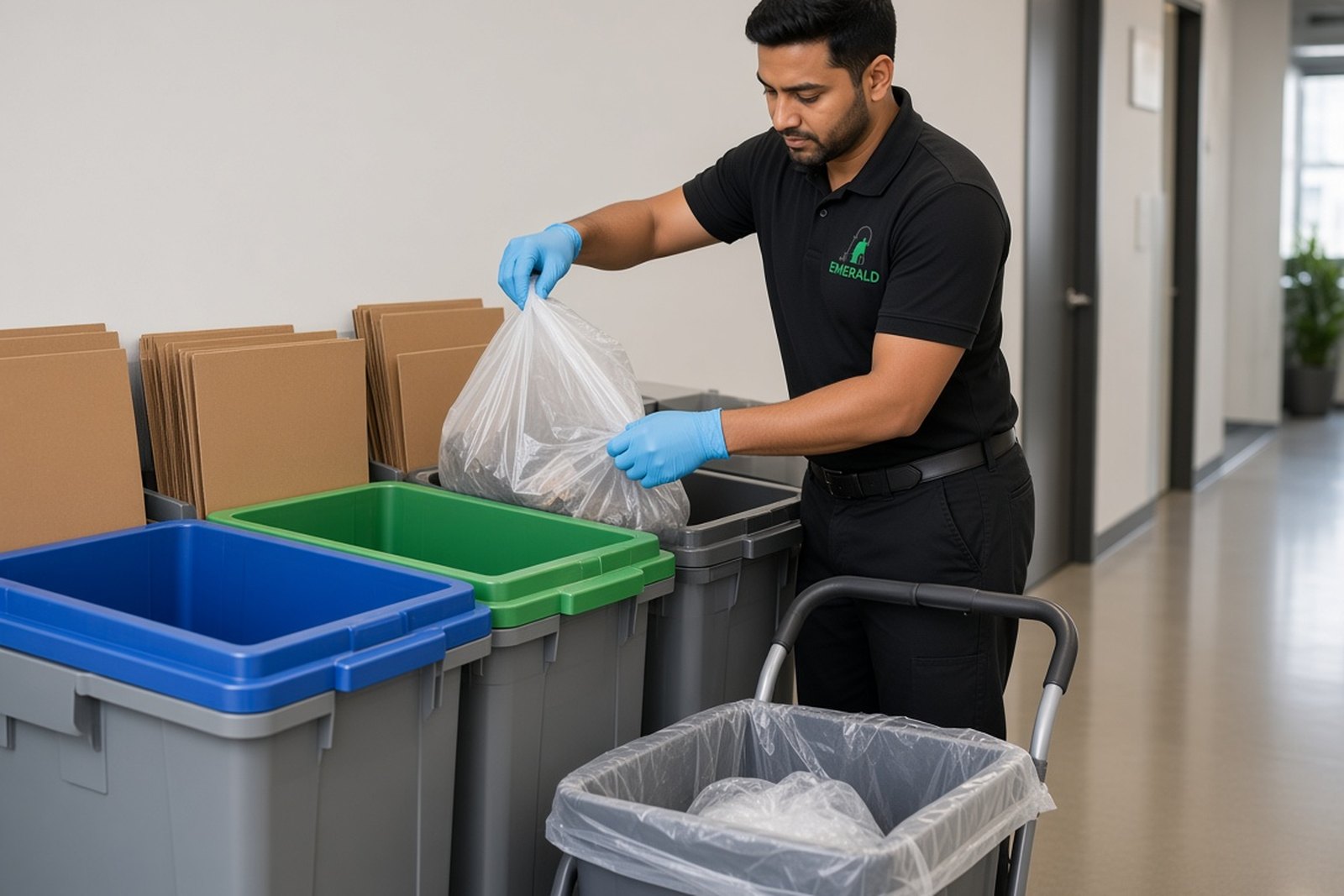
The first job is collection: emptying deskside and room bins, replacing liners, and moving material to a central point inside or beside the building. That is cleaning work, and it belongs in a janitorial scope with a stated frequency.
The second job is hauling: a licensed waste contractor removing material from the property on a schedule, with the bins, the tipping fees and the weight tickets. That is not cleaning work, and no janitorial rate includes it.
The third job is stream integrity: making sure the recycling bin actually contains recyclables. That is shared. A crew can consolidate correctly, but they cannot undo what went into a bin during the day. Signage, bin placement and staff habits decide this one, and no cleaning frequency compensates for a badly designed station.
Contamination is the failure mode, not volume
A single greasy pizza box in a paper stream can downgrade the load. A coffee cup with liquid in a mixed recycling bin does the same. When a facility gets told its diversion numbers are poor, the cause is almost always contamination rather than people failing to sort at all.
Bin design fixes more of this than instruction does. Pair every recycling bin with a garbage bin so there is never a lone recycling bin acting as a default; that lone bin is the single most reliable source of contamination in an office. Use consistent colours and lids across the whole building, and put the signage at eye level on the bin rather than on a wall poster.
Central stations generally beat deskside bins for stream quality, because people make a deliberate choice at a station and an unconscious one at their feet. They also cut collection labour, which shows up in the cleaning quote. If you are rewriting a recurring office cleaning scope anyway, it is the right moment to reconsider bin layout.
Organics is an odour and frequency problem
Organics collection is where a good plan turns bad fastest, because food waste does not wait for a weekly schedule. A kitchen organics bin needs daily removal from the room, a sealed central container, and a liner arrangement that actually gets changed rather than topped up.
Summer makes this worse and so does a warm interior loading area in winter. If a building has drain flies or a persistent sweet smell near the kitchen, look at organics frequency and the container seal before blaming the cleaning routine for the rest of the space.
Restaurants and food-service tenants are a different scale of the same problem, and they usually need grease and floor programs alongside waste. Our restaurant tile and grout cleaning page covers the floor side, which is normally where the odour is actually living.
Cardboard, confidential paper and the things that need their own line
Cardboard is a volume problem rather than a cleaning problem, and it hits retail and warehouse sites hardest. Flattening and staging cardboard takes real labour, so it should appear in the scope as its own item with a location and a frequency. Our warehouse and industrial cleaning and retail cleaning scopes treat receiving areas as a named zone for this reason.
Confidential paper and shredding is a separate service with its own chain of custody. A cleaning crew should not be the control point for documents that need certified destruction, and your scope should say so.
Electronics, batteries, light tubes and aerosols all need their own handling and should never ride along in general waste because they were sitting in a hallway. Name a holding location and a responsible person, and the problem largely disappears.
How to write it into a scope, and what Ontario businesses should confirm
Write waste as four lines: which rooms get collected, at what frequency, to which central point, and who supplies liners. Then write a fifth line naming who hauls and on what schedule, even if that is not us, so nobody assumes the material leaves the property on its own.
Confirm your municipal situation directly rather than assuming. Many Ontario municipalities do not provide recycling or organics collection to commercial properties, and businesses often need a private hauler. That is worth checking with your municipality before you design a three-stream program around collection you may not have.
Emerald Cleaners handles collection from named rooms to your designated point as part of a written commercial cleaning scope, and we will say plainly where our scope ends and a hauler's begins. To get that written up for your building, request a walkthrough or call 613-922-8074 Monday to Friday between 9 and 4.
Next step for this topic
Three-stream waste fails on contamination, not on effort. Here is how Eastern Ontario facilities should divide the work between the cleaning crew, the hauler and their own staff.
If that matches your building in Eastern Ontario, review commercial cleaning or request a free quote. Emerald Cleaners is at 108 Cannifton Rd N, Belleville, ON K8N 4Z6. Call 613-922-8074 Monday to Friday, 9 to 4. More in Office & Workplace and the resource centre.
Professional commercial cleaning across Belleville, Kingston, Quinte West, Napanee and surrounding communities.
 6 min
6 min