This guide shares practical considerations based on the kinds of commercial facilities our team serves across Eastern Ontario.
Licensed Ontario child care centres must have written sanitary practice policies and are inspected by public health. Here is how an after-hours cleaning contract becomes evidence for that policy instead of a gap in it.
Emerald Cleaners wrote this guide for commercial facilities in Eastern Ontario. It is operational advice for this topic, not a copied template and not medical or legal advice.
The requirement is a written policy, and the licensee owns it
Under Ontario Regulation 137/15 made under the Child Care and Early Years Act, every licensee must ensure there are policies and procedures for sanitary practices in each child care centre it operates. The regulation does not hand you a checklist. It requires that you have one, that staff follow it, and that you can produce it.
The same regulation requires that any direction from a medical officer of health affecting children's health or well-being is carried out by all staff at the centre. In practice that means your local public health unit can change your cleaning routine mid-year, and your written procedures have to be able to absorb that change.
A cleaning contractor cannot own that policy. What a contractor can do is be a documented, repeatable part of it, with named rooms and named frequencies that you can point to during an inspection. That is the difference between a cleaning invoice and actual evidence.
Split the day: staff routines during hours, contractor routines after close
Most of what public health cares about in a daycare happens while children are present. Diapering and toileting routines, hand hygiene, table sanitizing before and after food, and cleaning a toy that just went in a child's mouth are all in-the-moment tasks. They belong to educators, and they cannot wait for an evening crew.
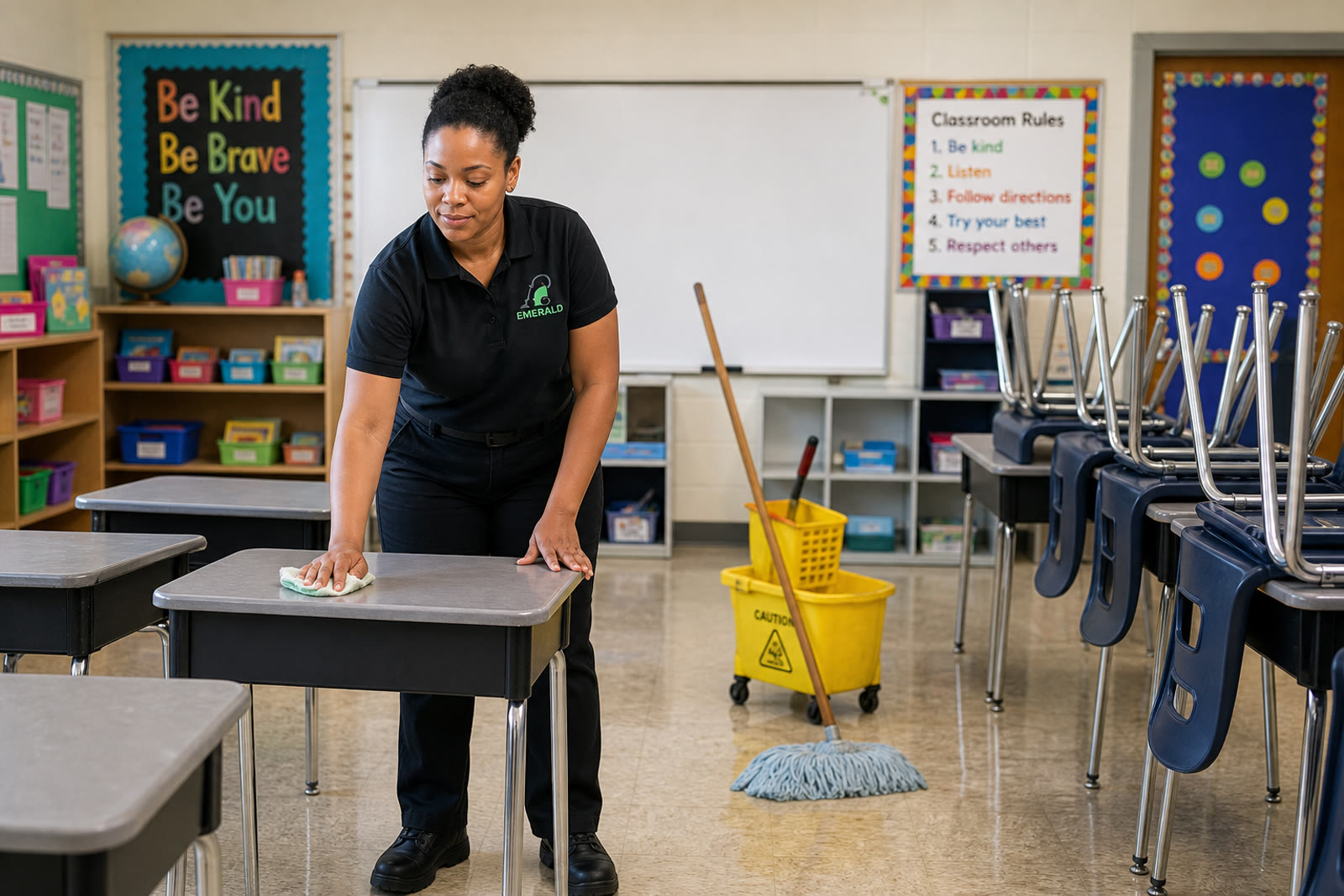
What belongs to an after-hours crew is the reset: floors, washrooms, cubbies and shared surfaces, kitchen and staff areas, waste removal, and the periodic detail work that never fits into a program day. Our school and daycare cleaning scope is written for exactly that window.
Write the split into two columns and post it. Almost every daycare cleaning dispute we have seen comes from a task sitting in neither column, and toys are the usual example. Decide whether toy sanitizing is an educator task on a rotation or a contracted periodic item, then put it in writing rather than assuming.
Dedicated tools are not a nice-to-have in a childcare setting
Mops and cloths used in washrooms and diapering areas must not be used anywhere else in the building. This is one of the clearest, least negotiable expectations in institutional cleaning specifications, and it is also one of the easiest things to get wrong when a crew is moving quickly with one bucket.
Ask your contractor how tools are separated, colour-coded and laundered, and ask it before you sign rather than after an inspection. A vendor that cannot answer in one sentence has not thought about childcare settings specifically.
Waste is the companion requirement. Diapering and kitchen waste should leave the building daily rather than sit in a bin overnight, and that frequency needs to be a line in the scope rather than an assumption about what a cleaner will obviously do.
Products, contact time and children in the room
Use a disinfectant licensed for the purpose, with a Health Canada Drug Identification Number, and give it the full contact time its label requires. Wiping a table dry immediately after spraying it is the most common failure in every setting, and a daycare is where it matters most.
Because children are in the space, product selection is a real conversation rather than a marketing one. Lower-impact chemistry can work well in a childcare setting, but only where the product still does the job the routine needs. Our green cleaning approach is about documented product choices and dilution control, not a vague non-toxic promise.
Ventilation and re-entry matter too. Anything applied after close should be dry and aired before children arrive, which is another reason the heavier work belongs in the evening rather than squeezed into a nap period.
Outbreaks change the routine, and the direction comes from public health
When a gastrointestinal or respiratory outbreak is declared, your local public health unit sets the response, and the regulation requires staff to carry out that direction. Enhanced high-touch frequency, changed product requirements and additional washroom service are all common.
Agree in advance how that surge gets handled. A contract with no mechanism for an outbreak visit turns a public health direction into an emergency negotiation on a Tuesday afternoon. A contract with a pre-agreed enhanced routine and a call-out rate turns it into a phone call.
If a specific space needs an assessed disinfection visit rather than an enhanced wipe-down, that is a separate work order. Our fogging disinfection page explains when that method is appropriate and when it is not, because it is an application method and not a guarantee.
What inspectors and parents actually notice
Public health inspects licensed child care settings at least annually, and the things that get written up are rarely exotic: washrooms, diapering areas, food surfaces, floors in eating areas and waste handling. Parents notice roughly the same list, plus the entry and the smell of the building when they walk in.
Eastern Ontario adds a seasonal variable. Salt and grit tracked through a vestibule in February ends up ground into classroom floors and washroom grout, so a winter mat plan and a defined entry clean protect the rest of the building. Centres in Belleville, Quinte West and Napanee all see the same pattern.
Emerald Cleaners provides cleaning to an agreed written scope and does not certify regulatory compliance on a licensee's behalf. If you want your after-hours routine documented properly, request a walkthrough or call 613-922-8074 Monday to Friday between 9 and 4. This guide is operational advice rather than legal advice, and your licence conditions and local public health direction always take precedence.
Next step for this topic
Licensed Ontario child care centres must have written sanitary practice policies and are inspected by public health. Here is how an after-hours cleaning contract becomes evidence for that policy instead of a gap in it.
If that matches your building in Eastern Ontario, review school and childcare cleaning or request a free quote. Emerald Cleaners is at 108 Cannifton Rd N, Belleville, ON K8N 4Z6. Call 613-922-8074 Monday to Friday, 9 to 4. More in Schools & Childcare and the resource centre.
Professional commercial cleaning across Belleville, Kingston, Quinte West, Napanee and surrounding communities.
 6 min
6 min