This guide shares practical considerations based on the kinds of commercial facilities our team serves across Eastern Ontario.
In late 2010 and early 2011, a C. difficile outbreak at St. Joseph’s Healthcare in Hamilton became one of the most widely reported examples in Ontario of how serious this infection can be, and of why cleaning methods matter. In a January 2011 report, the hospital had confirmed 101 cases since early November, including 64 acquired after admission, and 13 deaths. It had also called in a provincial team to review its cleaning methods. Those figures come from a hospital outbreak more than a decade ago, and later summaries used slightly different totals. The problem has not gone away. In October 2026, Ontario hospitals were still declaring C. difficile outbreaks, including the intensive care unit at Sault Area Hospital and a unit at South Muskoka Memorial Hospital in Bracebridge, where the hospital said it was using products effective against C. difficile spores.
This post is not a hospital outbreak plan, and it is not medical advice. It explains, in plain language, what medical, dental, physiotherapy, chiropractic and veterinary clinics in Belleville and the Quinte area should expect from a commercial cleaner when C. diff is a concern: why the spores survive many everyday disinfectants, which surfaces need extra attention, and how the work is split between clinic staff and the cleaner. If your clinic is dealing with a suspected case or outbreak, follow Southeast Public Health (formerly Hastings Prince Edward Public Health) first.
What C. difficile is
Clostridioides difficile, still often called Clostridium difficile, C. difficile or C. diff, is a bacterium that can cause mild to severe diarrhea and inflammation of the colon. The Public Health Agency of Canada (PHAC) describes it as the most frequent cause of infectious diarrhea in hospitals and long-term care facilities in Canada. Most cases occur in people who are taking certain antibiotics in high doses or over a prolonged period. Those antibiotics can reduce the usual bacteria in the gut, which allows C. difficile to grow and produce toxins that damage the bowel. Some people can carry the bacteria and not show symptoms.
People pick it up from spores in feces. Infection can happen if someone touches a contaminated surface and then touches their mouth. Health-care workers can also spread it if their hands are contaminated. PHAC notes that for healthy people, C. difficile does not pose a health risk, but older adults, people with other illnesses, and people taking antibiotics are at greater risk. In some circumstances it can be fatal.
Public Health Ontario adds that C. difficile is commonly acquired in hospitals, that it can cause severe illness resulting in death, and that it spreads by contaminated surfaces or equipment and by poor hand hygiene. Hospital C. difficile outbreaks are reportable in Ontario. A community clinic is not a hospital ward, but clinics still have washrooms, waiting rooms and high-touch surfaces, and they may see patients who have diarrhea or who have recently been in hospital or long-term care.
Why spores survive regular disinfectants
C. difficile is a spore-forming bacterium. Public Health Ontario’s environmental cleaning best practices put the practical difference this way: the vegetative (non-spore) form is readily killed with the disinfectants commonly used in health-care settings, but the spores are resistant to many disinfectants and can persist in the environment for months. Once those spores are ingested, they can become infectious again.
That is why a routine tidy with an ordinary cleaner, or with a disinfectant that has no C. difficile spore claim on the label, is not the same as sporicidal cleaning. Public Health Ontario’s significant-organisms FAQ says the spores “cannot be killed by many cleaning agents.” PHAC’s acute-care guidance makes a similar point: because C. difficile forms spores, it persists in the environment longer and resists routine disinfection more than bacteria that do not form spores.
Alcohol-based hand sanitizer is a clear example of the same limit. PHAC’s C. difficile fact sheet says alcohol-based hand rubs do not destroy C. difficile spores, and that they are less effective than washing with soap and water. The same caution applies to surface work: unless the product label has a C. difficile spore claim, do not assume it will inactivate spores, even if it is a familiar disinfectant.
Public Health Ontario says control of environmental C. difficile requires both thorough cleaning, to remove spores, and a sporicidal disinfectant, to inactivate the spores that remain.
What a sporicidal product is, and why contact time matters
A sporicidal agent is a product that can kill C. difficile spores when it is used at the correct concentration and for the required contact time. Public Health Ontario lists three types that have shown activity against C. difficile spores when used as the manufacturer recommends:
- sodium hypochlorite (bleach), at 1,000 to 5,000 parts per million
- improved hydrogen peroxide, at 4.5%
- peracetic acid, at 0.26%
Those concentrations come from Ontario’s best-practice document. They are not a homemade mixing recipe for your clinic, and not every bleach or hydrogen peroxide product is suitable for every surface. The practical test is the label. In Canada, an authorized hard-surface disinfectant has an eight-digit Drug Identification Number (DIN) from Health Canada. For C. diff, look for a product whose label also has a claim against C. difficile spores, and then follow that label for dilution, wet contact time, compatible surfaces and safety directions.
Contact time is the time the surface must remain wet. Public Health Ontario’s key elements for environmental cleaning are plain on this point: know the contact time, keep the surface wet for that full period, let it air dry, and do not wipe the product off early. A quick spray-and-wipe that dries in seconds does not meet a label that asks for several minutes of wet contact. Some products are cleaner-disinfectants that clean and disinfect in one step when the label supports that use. If you are using more than one product, do not mix them. It is dangerous, for example, to mix a quaternary ammonium product with bleach.
Emerald does not stock or promise a specific sporicidal brand, and we do not claim a “hospital-grade” credential. We use the products your clinic specifies, or we discuss suitable DIN options with a C. difficile spore claim at the walkthrough, including whether the surfaces in your rooms can tolerate them. Whatever is agreed goes into the written scope, and we use it according to the label.
Clean, then disinfect: high-touch surfaces in a clinic
Disinfectant does not replace cleaning. Public Health Ontario says surfaces should be cleaned before they are disinfected. Soil, residue and organic matter can get in the way of the product working. After the surface is cleaned, the sporicidal product is applied and left wet for the full contact time.
High-touch surfaces are the ones hands meet all day. Public Health Ontario’s examples include doorknobs, call bells, bed rails, light switches, toilet handles, handrails and keypads, as well as wall areas around the toilet. In a clinic, the list usually includes:
- washrooms, including toilet flush handles, seats, taps, dispensers and door hardware
- door handles and light switches throughout reception, corridors and treatment rooms
- counters, reception desks and check-in surfaces
- waiting-room chairs and chair arms
- treatment tables and bed rails, when those surfaces are part of the agreed environmental clean
Washrooms deserve particular attention. Public Health Ontario recommends a sporicidal agent for the bathrooms of patients with C. difficile infection, and also for routine cleaning of bathrooms in ambulatory areas where those patients are often seen. It also says high-touch surfaces should be cleaned and disinfected at least once a day, and more often in outbreak areas. In hospitals, rooms and bathrooms of patients with C. difficile infection are often cleaned twice a day. That hospital frequency is not automatically the schedule for every outpatient clinic. How often each room is cleaned is set in your written quote after a walkthrough. If Southeast Public Health, or your clinic’s own infection-control lead, asks for enhanced or more frequent washroom and high-touch cleaning, that belongs in the scope rather than being assumed.
The same “clean, then disinfect, and keep it wet” approach is the one we described in our post on disinfecting an office or gym after norovirus. The product claim is different — a norovirus (or virucidal) claim is not the same as a C. difficile spore claim — so the bottle still has to be checked, not assumed.
Soap and water beats sanitizer for C. diff on hands
Surface work is only part of the picture. PHAC says frequent hand hygiene is the most effective way to prevent the transmission of health-care associated infections, and that washing with soap and water is important during C. difficile outbreaks. Alcohol-based hand rubs do not destroy the spores. They may be used if soap and water are not available, but PHAC is clear that they are less effective than handwashing.
PHAC’s acute-care guidance prefers soap and water over alcohol-based hand rub in settings with C. difficile transmission and during outbreaks, because washing physically and mechanically removes spores. If a sink is not available right away, alcohol-based hand rub can be used, and hands should be washed with soap and water as soon as a suitable sink is available. Gloves are recommended when caring for a person with C. difficile or when touching that person’s environment, with handwashing after the gloves come off.
For a clinic, that usually means soap, running water and paper towels must be easy to use in staff and public washrooms, and that sanitizer at the entrance is a supplement, not a substitute, when C. diff is a concern.
Who does what: clinic staff and the cleaner
Ontario infection-control guidance separates housekeeping from clinical cleaning, and a good clinic scope puts that split in writing. Public Health Ontario also says responsibilities for cleaning and disinfecting shared equipment should be clearly defined.
Your clinic team keeps:
- Disinfecting clinical contact surfaces and patient equipment between patients, including items such as treatment tables, exam-table surfaces used during appointments, blood pressure cuffs and similar non-critical equipment
- Chairs, instruments and clinical contact surfaces in dental operatories
- Sterilizing instruments and medical equipment
- Your infection-control policy and any directions from Southeast Public Health
- Regulated or biomedical waste
- The first response to a body-fluid spill, following public health guidance and your own clinic procedure
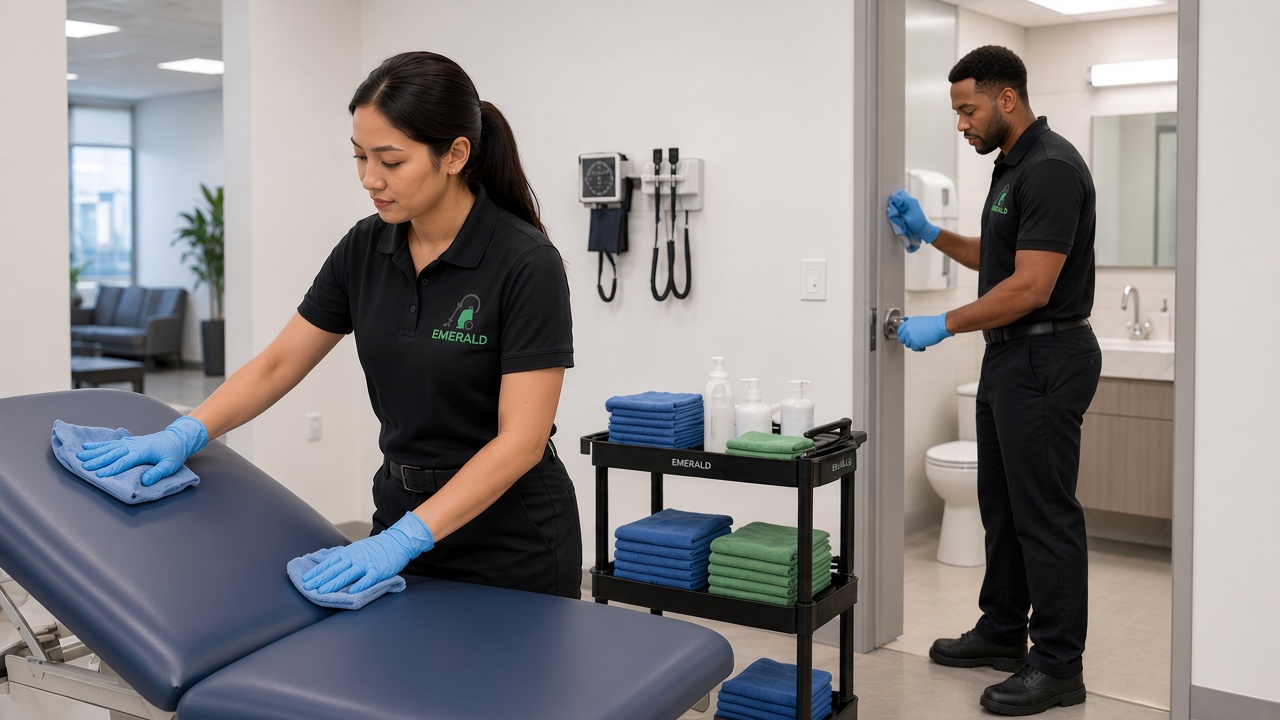
The cleaner handles, in the rooms named in the quote:
- Scheduled environmental cleaning of floors, counters, waiting-room furniture, staff rooms and general waste
- High-touch surfaces such as door handles, light switches, chair arms and washrooms
- When you ask for it, scheduled environmental cleaning with the sporicidal products your clinic specifies, including the agreed contact time, often after the last appointment
We do not sterilize medical equipment, and we do not take over clinical disinfection between patients. Our service does not include a guarantee of regulatory compliance, disease prevention or a particular health outcome. We also do not offer biohazard or trauma cleanup. If there is a spill of blood or other body fluid, clinic staff should contain and clean it first, following public health guidance. An environmental cleaning visit can then cover the agreed surrounding surfaces. Window cleaning, debris hauling, and drain cleaning or drain repair are not services we offer.
This is the same split already described on our medical office and clinic cleaning page for family practices, dental offices, physiotherapy and chiropractic clinics and veterinary clinics in Belleville, Kingston, Trenton and Quinte West, Napanee and nearby towns.
If public health is involved
This article is general information for clinic managers. It is not medical advice, and it is not a substitute for the direction of your clinician lead or the public health unit. Hospital C. difficile outbreaks in Ontario are reportable, and they are managed with the local public health unit. A clinic that has a suspected case, a cluster of illness, or a request for enhanced cleaning should contact Southeast Public Health (formerly Hastings Prince Edward Public Health) and follow the instructions it gives, including the product, the rooms and the frequency. We will work to a written scope that reflects those instructions, rather than inventing a protocol of our own.
Need a clinic cleaning plan in Belleville or the Quinte area?
We’ll walk your site, work after hours when you need the rooms empty for contact time, and put the surfaces, products and schedule in a written plan.
A typical walkthrough covers the rooms in your clinic, which high-touch surfaces are in scope, which products you want used, when the building can be vacant, and how we will get in. It does not include window cleaning, debris hauling, drain cleaning, biohazard or trauma cleanup, sterilization, or clinical contact surfaces between patients, unless a written quote expressly adds work that is within our service. Cleaning and disinfection cannot guarantee disease prevention or a particular health outcome.
Frequently asked questions
Is medical clinic cleaning in Belleville the same when C. diff is a concern?
A regular visit keeps waiting rooms, washrooms, floors and high-touch surfaces presentable. When C. diff is a concern, the environmental work also has to account for spores: clean the surface first, then apply a disinfectant whose label has a C. difficile spore claim, and leave the agreed surfaces wet for the full contact time. That may need empty rooms and more time than a nightly tidy. See our medical office and clinic cleaning page for how a clinic scope is written. Cleaning and disinfection cannot guarantee that no one will get sick.
What disinfectant kills C. diff spores?
Use a product that has a Health Canada Drug Identification Number (DIN) on the label and a claim against C. difficile spores. Public Health Ontario lists sodium hypochlorite (bleach), improved hydrogen peroxide and peracetic acid as agents that have shown activity against the spores when used at the manufacturer’s concentration and contact time. Follow the label for dilution, wet contact time and safety, and do not mix products. Many everyday cleaners, and many disinfectants without a spore claim, will not do this job. We confirm the product and the surfaces at the walkthrough rather than promising a brand in advance.
Do you clean dental, physio, chiro and vet clinics, or only medical offices?
Yes. Along with family practices and medical offices, we clean dental offices, physiotherapy and chiropractic clinics and veterinary clinics in Belleville, Kingston, Trenton and Quinte West, Napanee and nearby towns. In every clinic, chairs, instruments and clinical contact surfaces stay with your clinic team. The environmental clean covers the waiting room, reception, corridors, staff rooms, washrooms, floors and the other non-clinical areas named in your quote, including sporicidal cleaning of agreed surfaces when you ask for it.
Who cleans treatment tables, patient equipment and body-fluid spills?
Clinic staff handle clinical contact surfaces and patient equipment between patients, and they handle the first response to a body-fluid spill, following public health guidance and your clinic procedure. We do not offer biohazard or trauma cleanup. The cleaner’s job is the scheduled environmental clean of the rooms in the quote — floors, washrooms, waiting-room furniture, door handles, light switches and other agreed high-touch surfaces — using the products you specify. If a treatment table is included as part of an after-hours environmental clean, that will be written into the scope, and it does not replace between-patient disinfection by your team.
Is this medical advice, and what should we do if we think we have an outbreak?
No. This is general information, not medical advice and not an outbreak-management plan. If you have a suspected case, a cluster of illness, or a request for enhanced cleaning, contact Southeast Public Health (formerly Hastings Prince Edward Public Health) and follow its directions. For a walkthrough, have a list of the rooms involved, your access instructions, any surfaces that cannot be wet or should be left alone, the products you want used, and any directions you have already received from public health. If you already have a regular cleaning scope, bring that too. Overnight and after-hours visits can be scheduled so the product can stay wet for the full contact time. We do not promise a set arrival time.
Professional commercial cleaning across Belleville, Kingston, Quinte West, Napanee and surrounding communities.
 14 min
 6 min
 6 min