This guide shares practical considerations based on the kinds of commercial facilities our team serves across Eastern Ontario.
Norovirus is a common cause of sudden vomiting and diarrhea. Public health agencies often call it a stomach bug, and it is not the flu. The Public Health Agency of Canada notes that it spreads very easily and quickly, and that it only takes a few virus particles to make someone sick. People can pick it up by touching a contaminated surface and then touching their mouth before washing their hands. Outbreaks can happen at any time, but they are most common in the fall and winter, which is why this is the season offices, clinics, stores and gyms in Belleville, Trenton, Quinte West and the towns between start asking about office disinfection in Belleville.
A nightly tidy is not the same job. Routine office cleaning or gym and fitness cleaning keeps a building presentable. An outbreak-style visit is a defined extra: soil comes off first, then a disinfectant that actually has a norovirus claim is left wet for the full time on the label, on the rooms and high-touch surfaces you have agreed in writing. For the service offer itself, see our site-assessed cleaning and disinfection page. This guide explains what should change after a stomach bug, what your own team can do between visits, and when to book extra or after-hours work. It is not medical advice. Cleaning and disinfection cannot guarantee that no one will get sick.
If Southeast Public Health, formerly Hastings Prince Edward Public Health, has declared an outbreak in your workplace or given you written instructions, follow those instructions first.
Why an outbreak clean is not a routine tidy
Norovirus is harder to deal with than many everyday germs. Health Canada explains that it is a non-enveloped virus, and that non-enveloped viruses are more resistant to surface disinfectants than enveloped ones. Public Health Ontario also notes that the virus can remain on surfaces for up to 12 days, and that contaminated surfaces and equipment play a significant role in spread.
That is why a quick spray-and-wipe during a regular visit is not norovirus cleaning in Belleville. A disinfectant only does what the label describes if the surface was cleaned first, the product is actually intended for that organism, and the surface stays wet for the full contact time. A wipe that is dry in a few seconds has not met a minutes-long wet time. Our fogging versus spray disinfection guide puts it the same way: nightly commercial cleaning is soil removal and presentation; a disinfection visit is a defined extra with its own chemistry. Do not fold that request into a short nightly list and expect the same result.
Emerald Cleaners offers site-assessed cleaning and disinfection, and assessed fogging where the site and the selected product support it. We do not advertise kill-rates, hospital-grade slogans, or health outcomes. If a product cannot be used as labelled in your space, we will say no.
Which high-touch surfaces matter
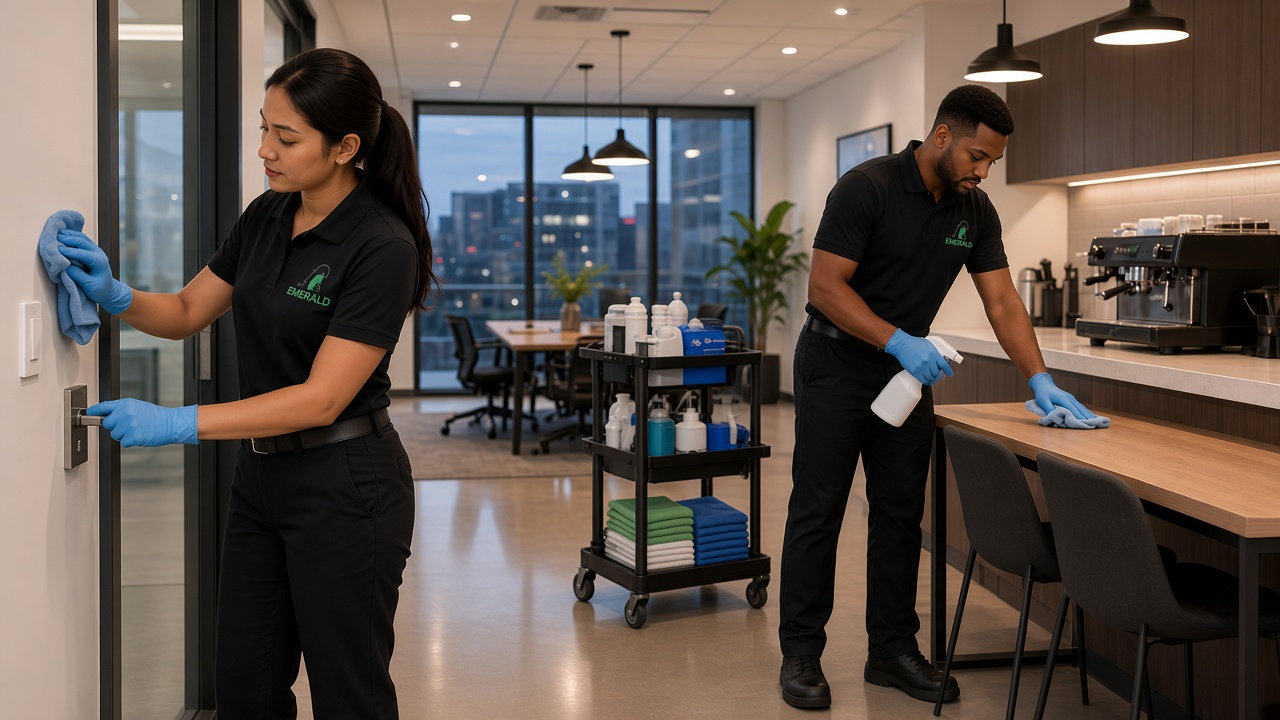
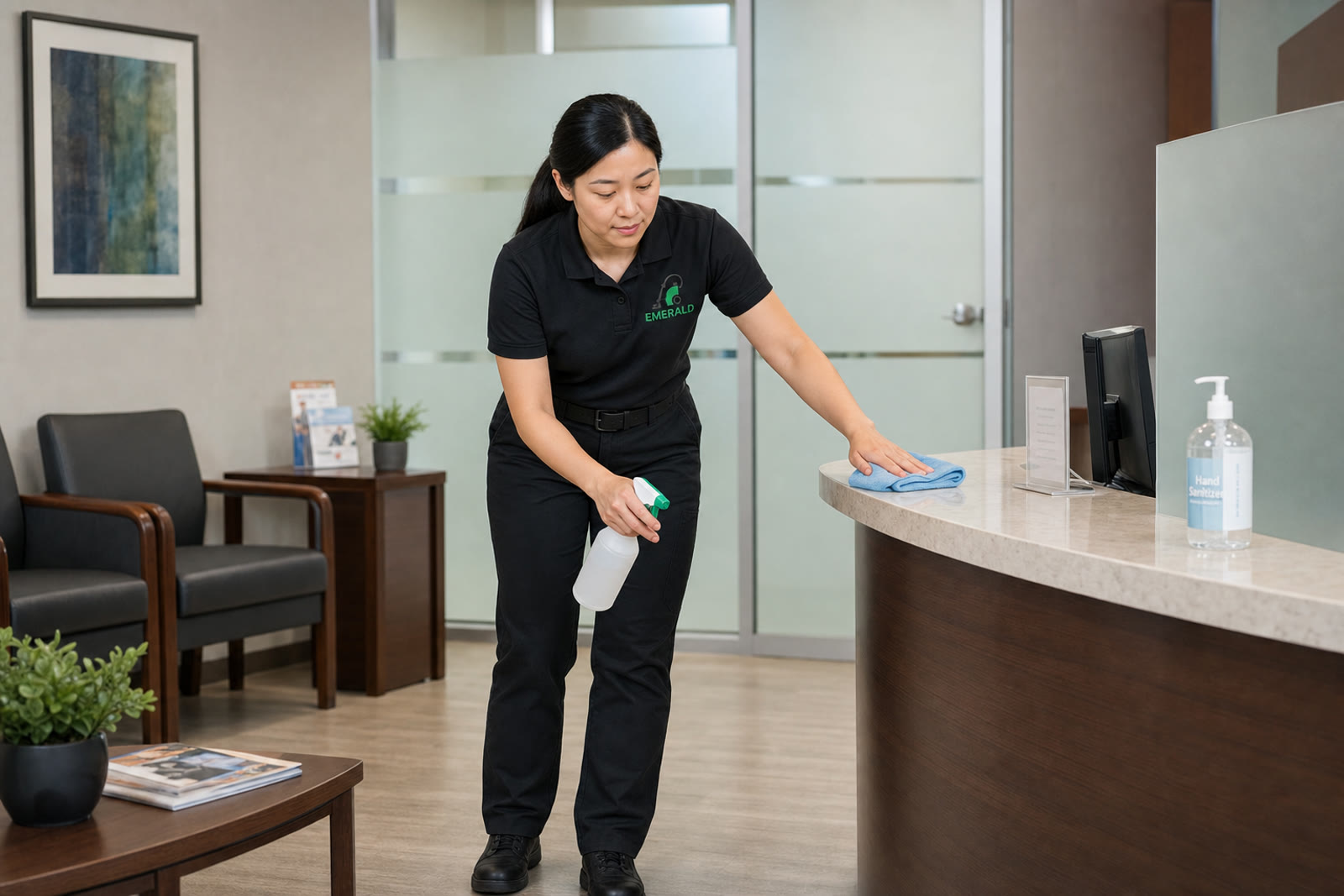
The virus spreads from person to person, and from surfaces people actually touch. After an illness in the building, prioritize the rooms that were used and the hardware everyone shares, not only the floors that look dirty.
In an office, that usually includes:
- Door handles, push plates, locks and light switches
- Reception counters, sign-in pens, shared phones and payment terminals
- Elevator buttons, stair rails and access-control keypads
- Shared keyboards, mice, conference-room remotes and chair arms
- Kitchenette and break-room taps, fridge handles, microwave and coffee equipment, tabletops and the handles of shared appliances
- Washroom fixtures, dispenser levers, partition latches and taps
In a gym or fitness studio, add:
- Equipment frames, handles, grips and console faces
- Free-weight racks, benches, mats and studio floors, as the surface allows
- Change-room benches, locker handles and hooks
- Shower and wet-area fixtures, and washroom touchpoints
- Reception, water-fountain or bottle-fill buttons, and shared stretching areas
Public Health Ontario’s environmental-cleaning guidance is written for health-care settings, but the high-touch idea is the same: door handles, light switches, toilet handles, handrails and similar points should be cleaned and disinfected at least daily, and more often in an outbreak area. Our holiday restroom checklist lists the washroom fixtures that get touched the most. Use that list for the washroom, then add the office or gym hardware above.
Electronics and porous fabrics are easy to get wrong. Confirm what the product label allows before soaking a keyboard, a fabric chair or a gym mat. If a surface cannot stay wet for the required time, or the label does not allow that use, leave it out of the disinfection scope rather than improvising.
Clean first, then disinfect — and leave it wet
Two steps matter more than the brand name on the bottle.
1. Clean first. Soil, dust and body fluids get in the way of a disinfectant. Public Health Ontario’s environmental-cleaning guidance is direct: clean surfaces before you disinfect them. Remove visible soil with a detergent or a cleaner, and only then apply the disinfectant, unless you are using a product whose label expressly allows a combined clean-and-disinfect step on a surface that is not heavily soiled. Never mix a disinfectant with another cleaner unless the label says the two can be used together. Mixing bleach with some other products can be dangerous.
2. Use a product that is actually authorized for the claim, and keep it wet. In Canada, an authorized surface disinfectant carries an eight-digit Drug Identification Number, or DIN, issued by Health Canada, shown on the label after the letters “DIN”. A DIN means the product has been authorized for sale. It does not, by itself, mean the product works against norovirus. The Eastern Ontario Health Unit advises facilities to choose a disinfectant whose label claims activity against norovirus, or against “Norwalk-like viruses” or feline calicivirus, which is the usual laboratory stand-in. Bleach-based products can be an option when the label supports that use and the surface can tolerate them. Public Health Ontario notes that most quaternary ammonium compounds do not have significant activity against norovirus and should not be used for this purpose, unless you have a specific product whose label actually carries the claim.
The surface must stay visibly wet for the full contact time on the label. Contact times vary by product, from about a minute to much longer. If it dries early, the label directions have not been met. Do not spray and immediately wipe dry. Plan the visit so rooms can stay unused while the product works.
Public Health Ontario also advises against vacuuming carpets and buffing floors during a norovirus outbreak, because those methods can throw particles back into the air. A regular office or gym plan may still include HEPA vacuuming at other times. During outbreak-style work, follow that public-health caution unless the local public health unit tells you otherwise.
Fogging is an application method, not a shortcut around these steps. Physical cleaning may still be required first, and fogging is only offered where the assessment, the selected product and the label directions support it. See our fogging disinfection page and the comparison of fogging and spray methods if you want to discuss that option.
Washrooms, break rooms and shared equipment
Washrooms, kitchenettes and shared equipment are usually where a stomach bug keeps moving, because many people touch the same surfaces and then eat, drink or touch their faces.
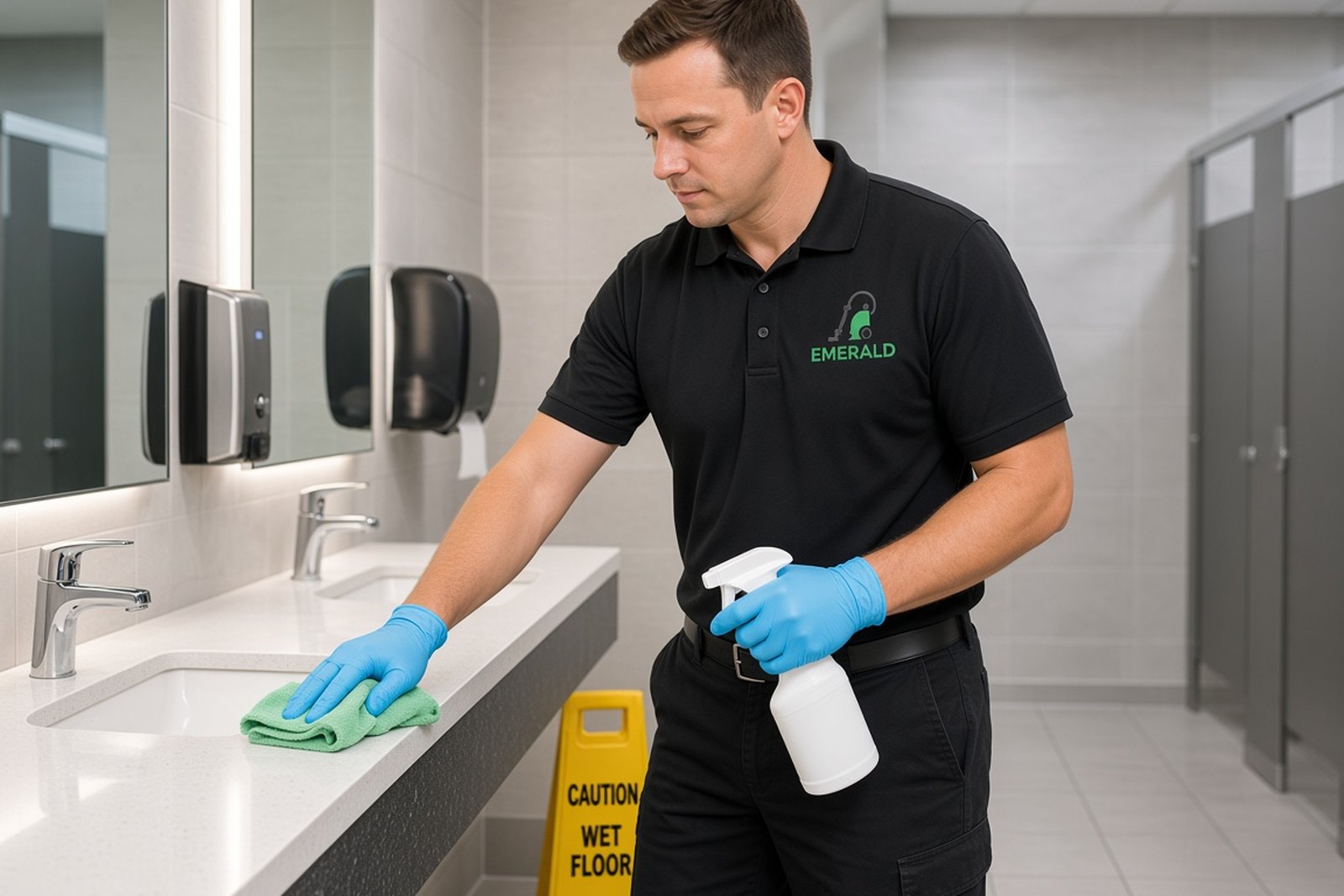
- Washrooms. Clean and then disinfect fixtures, taps, flush handles, dispensers, door hardware, partitions and the floor after an incident, and more often while people in the building are still ill. Restock soap and paper towels so staff can wash with soap and water. Slow drains should be reported to your plumber or landlord; Emerald Cleaners does not clean or repair drains. Year-round washroom standards are in our commercial restroom cleaning guide.
- Break rooms. Tables, chair backs, fridge and microwave handles, coffee equipment, taps and cupboard pulls belong on the same list. People who have been ill should not prepare or serve food or drink for others. The Public Health Agency of Canada advises waiting until three days after recovery before caring for or serving others; follow any different instruction from Southeast Public Health.
- Shared office and gym equipment. Wipe and disinfect the exterior surfaces people actually touch: handles, consoles, benches, mats if the label allows it, and reception hardware. In a gym, change rooms and showers need their own pass, because wet areas and lockers are high-touch. We clean accessible exterior surfaces of fitness equipment to the agreed scope. Equipment interiors, and manufacturer-specified servicing of machines, are not included, matching our gym and fitness cleaning page.
If someone vomits or has diarrhea in the building, public health guidance is to deal with that area promptly: keep other people away, wear disposable gloves, lift the soil with disposable towels, clean, then disinfect, bag the waste, and wash hands with soap and water. That immediate spill response is the occupant’s first step, following local public health advice. It is not the same job as a later, planned disinfection visit, and it is not biohazard or trauma cleanup, which we do not offer.
Match the plan to the building
The method is the same; the rooms and the rules are not.
- Offices. Reception, meeting rooms, open work areas, kitchenettes, washrooms and shared equipment are the usual core. Agree which desks should be cleared and which electronics can be treated.
- Gyms, studios and recreation sites. Equipment touchpoints, change rooms, showers, studio and rubber floors, and washrooms take priority. Name floor types, because a method that is fine on hard tile can be wrong for a rubber floor or a porous mat.
- Dental, physio, chiro and vet clinics. Waiting rooms, corridors, staff rooms and washrooms can go on an assessed disinfection plan. Chairs, instruments and clinical contact surfaces stay with your clinic team, as on our medical office and clinic cleaning page. A clinic should also follow its own infection-control policy.
- Retail, plants and other commercial sites. The same clean-then-disinfect sequence applies to staff rooms, washrooms, break areas and agreed customer touchpoints. We clean the floors and supporting rooms around production, not production equipment, unless a written quote expressly adds that work.
Overnight and weekend visits are something we already plan year-round, around keys and alarm instructions. That window is often the right one for disinfection, because rooms can stay empty for the contact time.
What your team should do between visits
A contracted visit cannot replace what happens during the business day.
- Ask people who are ill to stay home. The Public Health Agency of Canada says infected people are most contagious while they have symptoms and for at least three days after they recover, and that some people remain contagious for longer. Southeast Public Health may give a specific exclusion period, especially if an outbreak is declared. Use that instruction.
- Wash hands with soap and water after using the washroom, before eating or preparing food, and after any cleanup. Several Ontario public health units, including Niagara Region, are clear that alcohol-based hand sanitizer does not work well against norovirus and is not a substitute for handwashing. Sanitizer can still be available; it should not be the only method you rely on.
- Keep soap, paper towels and liners stocked. An empty soap dispenser makes the rest of the plan weaker.
- During the day, have someone wipe and, where you have a suitable product, disinfect the busiest handles, counters and equipment, especially in a gym between peak classes.
- Do not prepare or serve food for others while ill, and follow public health advice on when it is reasonable to return to that task.
- If several people in the workplace become ill, contact Southeast Public Health for guidance. If they declare an outbreak or issue directions, follow them.
When to book an extra or after-hours disinfection visit
Book a defined, assessed visit when the regular schedule cannot do this work properly. Typical reasons include:
- Someone has been ill with vomiting or diarrhea in the building, and you want the affected rooms and high-touch surfaces cleaned and then disinfected after the immediate spill has been handled
- Several staff, members or customers have had a similar stomach bug
- You want the work done after hours or on a weekend, so the disinfectant can stay wet for the full contact time before people return
- Southeast Public Health has asked for enhanced cleaning and disinfection
Tell us which rooms were involved, when the building can be empty, how we will get in, and whether you already have a product preference. We will walk the site, confirm surface compatibility, and put the rooms, the method and the exclusions in a written quote. We do not promise a set arrival time. Access, vacancy and the contact time on the label decide when the visit can actually run.
What is in a typical assessed disinfection visit, and what is not
A typical plan, once it is written down, can include:
- A review of priority rooms and accessible touchpoints
- Cleaning before disinfection where it is required
- Manual application to compatible, agreed surfaces in offices, gyms, washrooms, break rooms and other rooms in the scope
- Label-directed contact-time planning, with access and ventilation coordinated with your site contact
- After-hours or weekend scheduling where the building can stay unused
- Documentation of the areas included in the quote
It does not include window cleaning, debris hauling, or drain cleaning or drain repair; those are not services we offer. It also does not include biohazard or trauma cleanup, cleaning of production equipment, or of clinic chairs, instruments and clinical contact surfaces, unless a written quote expressly adds work that is within our service. Equipment interiors and manufacturer servicing of fitness machines are not included. Fogging is included only when it has been assessed and quoted. Cleaning and disinfection cannot guarantee disease prevention or a particular health outcome.
A practical checklist for stomach-bug season
- If several people are ill, or public health is involved, follow Southeast Public Health (formerly Hastings Prince Edward Public Health) first.
- Keep people who are ill off site, and use soap-and-water handwashing as the main hand-hygiene method.
- After an incident, close off the affected area, handle the soil safely, then clean and disinfect.
- List the high-touch surfaces in each room, including washrooms, break rooms and shared equipment.
- Use a Health Canada–authorized disinfectant with a DIN and a norovirus claim on the label. Follow the dilution, wet contact time and safety directions.
- Do not spray and wipe dry. Do not mix products. Do not vacuum carpets or buff floors during an outbreak unless public health says otherwise.
- Stock soap, towels and liners, and wipe busy handles during the day between contracted visits.
- Book an extra or after-hours visit when the regular clean cannot cover the rooms and the contact time. Put the scope in writing.
Need a hand with office or gym disinfection?
We'll walk your site, work after hours when you need the rooms empty, and put the high-touch surfaces and contact time in a written plan.
Frequently asked questions
Is office disinfection in Belleville after norovirus the same as a regular office clean?
No. A regular visit keeps the building presentable. After a stomach bug, the work is a defined extra: clean the soil off first, then apply a disinfectant whose label has a norovirus claim, and leave the agreed high-touch surfaces wet for the full contact time. That usually needs empty rooms and more time than a nightly tidy. See our site-assessed cleaning and disinfection page for how that visit is scoped. Cleaning and disinfection cannot guarantee that no one will get sick.
What disinfectant should we use for norovirus cleaning in Belleville?
Use a product that has a Health Canada Drug Identification Number (DIN) on the label, and a claim against norovirus, “Norwalk-like viruses,” or feline calicivirus. Bleach-based products can be suitable when the label supports that use and the surface can tolerate them. Follow the label for dilution, wet contact time and safety, and do not mix products. Most ordinary cleaners, and most quaternary ammonium products, do not have this claim. We confirm the product and the surfaces at the walkthrough rather than promising a brand in advance.
Can you do this work in a gym or a clinic, not only an office?
Yes. The same clean-then-disinfect approach applies to gyms, studios and recreation sites, and to waiting rooms, corridors, staff rooms and washrooms in dental, physio, chiro and vet clinics, as well as to other commercial sites in Belleville, Trenton, Quinte West, Napanee, Kingston and nearby towns. In clinics, chairs, instruments and clinical contact surfaces stay with your clinic team. In gyms, we clean accessible exterior equipment surfaces, change rooms and washrooms to the agreed scope, not machine interiors.
When should we book an extra or after-hours disinfection visit?
When someone has been ill in the building, when several people have had a similar stomach bug, when you need the rooms empty so the product can stay wet for the full contact time, or when Southeast Public Health has asked for enhanced cleaning. Overnight and weekend visits are already part of how we schedule commercial work. When you request a quote, tell us which rooms were involved, when the building can be vacant, and how we will get in. We do not promise a set arrival time.
What should we do ourselves, and what should we have ready for a walkthrough?
Ask people who are ill to stay home, make soap-and-water handwashing easy, stock washrooms and break rooms, and handle an immediate spill following public health guidance before a planned visit. Alcohol-based hand sanitizer is not a substitute for handwashing against norovirus. For the walkthrough, have a list of affected rooms, your access and alarm instructions, any surfaces that cannot be wet or should be left alone, and any directions you have already received from Southeast Public Health. If you already have a regular cleaning scope, bring that too.
Professional commercial cleaning across Belleville, Kingston, Quinte West, Napanee and surrounding communities.
 6 min
 6 min
 6 min